Portraits from the shifting edge of identity.
Abstracts - Emotion reduced to its elemental geometry.
My artworks are offered in limited editions of 5.
All artworks are printed on archival canvas and are mounted on a Float Frame.
Ready to Hang
Free Shipping
Click Image


A Very Short History of Portraits in Art - 06.21.2026
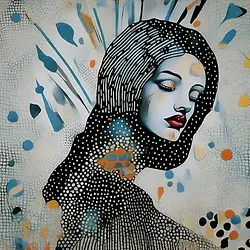
Click Image
Portraits have been with us for as long as we’ve been trying to understand ourselves. The earliest known examples—carved faces on ancient Egyptian funerary masks and Roman ancestor busts—weren’t about likeness alone. They were vessels of memory, identity, and status, meant to hold a person in the world even after they were gone.
During the Renaissance, portraiture shifted from symbolic presence to psychological presence. Artists like Leonardo and Titian began treating the face as a site of interior life, using light, gesture, and composition to suggest thought, mood, and complexity. A portrait became less about recording a person and more about revealing them.
By the 19th century, photography disrupted everything. Suddenly, likeness was easy. Painters responded by pushing into interpretation—looser brushwork, expressive color, and the beginnings of abstraction. Modernism took this further: Picasso fractured the face, Matisse flattened it, and artists across the century treated the portrait as a place to question identity rather than confirm it.
Today, portraiture is one of the most elastic forms in contemporary art. It can be figurative or abstract, digital or painted, intimate or theatrical. What remains constant is the impulse behind it: the desire to see a person not just as they appear, but as they feel, remember, imagine, or transform.